
Home › Regulations and Standards
UDI explained: what the identifier contains and why it matters
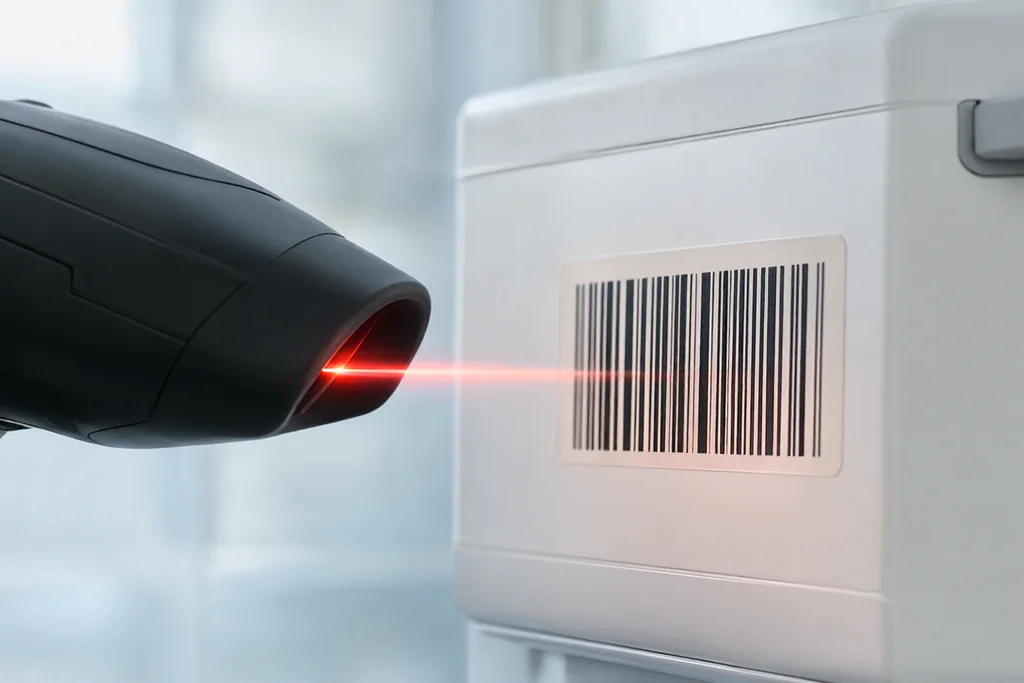
A unique device identification system gives every medical device a code that means the same thing to the manufacturer, the hospital and the regulator. The idea is simple and the implementation is not. Once a device carries a standard identifier, its inventory record, its service history, its recalls and its adverse event reports can all be tied to the same object instead of to a description somebody typed.
What the Identifier Actually Contains
A UDI has two parts. The device identifier is fixed: it identifies the model and the manufacturer, and it does not change from one unit to the next. The production identifier is variable: it carries the lot or batch, the serial number, the expiry date or the manufacturing date, depending on what the device requires.
Both parts travel together on the label, usually as a barcode, and sometimes as a direct mark on the device itself when the device is reprocessed or too small for a label to survive. A scanner reads one string; the database behind it resolves the two halves.
Who Assigns It, and Where It Is Recorded
Manufacturers do not invent the code. They obtain it from an issuing agency accredited for the purpose, and the common ones are GS1, HIBCC and ICCBBA, each with its own syntax and its own conventions for the production identifier.
The manufacturer then submits the device identifier and a set of core attributes to a public database: GUDID in the United States, and the European database established under the MDR in the European Union. The record is what makes the code useful, because a barcode on its own says nothing about what the device is.
Why It Matters in Inventory
Hospitals hold the same equipment as models, as individual units and as consumables, and the identifier is the only field that can join those views. Scanning the label at receipt removes a category of transcription error and gives the asset record a key that survives reordering and reprinting.
It also changes what a recall search looks like. Instead of matching a free-text description against a list and hoping the punctuation agrees, the team can query by device identifier and lot. Our guide to managing a medical device inventory covers where those records usually break down in practice.
Recalls and Post-Market Signals
Recall notices are written against identifiers. When a manufacturer or a regulator issues a field safety notice, the affected devices are described by device identifier and, where relevant, by lot or serial range. A hospital that has captured those fields can answer the only question that matters in the first hour: do we have any.
The same key works in reverse. Adverse event reports, service records and complaint data can be aggregated by device identifier, which is what allows a pattern to emerge across sites rather than staying invisible inside one department. That is the mechanism behind post-market surveillance, and it only works if the identifier was captured at the point of use.
| Component | What it identifies | Typical use |
|---|---|---|
| Device identifier | Model and manufacturer | Inventory, catalogue, recall matching |
| Production identifier, lot | Batch of manufacture | Recall scope and sterility release |
| Production identifier, serial | One individual unit | Service history and traceability |
| Production identifier, dates | Expiry or manufacture date | Stock rotation and recall checks |
| Direct mark | The device itself, without a label | Reusable and reprocessed instruments |
Where Records Break Down
The failures are mundane and repetitive. None of them is a technology problem, and almost all of them are visible in the first month of a scanning program.
- Labels damaged or removed during reprocessing, leaving the unit unidentifiable.
- Barcodes read as free text, so the identifier is stored but never parsed into fields.
- Production identifiers dropped at receipt because only the model seemed relevant.
- Loaner sets and consignment stock entering the building without a scanning step.
- Direct marks unreadable after repeated cleaning and disinfection.
- Two identifiers for the same product after a manufacturer acquisition or rebrand.
What Implementation Requires
The technical work is smaller than the process work. Scanners and a database field are straightforward; deciding that every receiving dock, procedure area and service visit captures the identifier is not, and that decision is what determines whether the system produces anything usable.
A realistic sequence starts with the highest-value categories, which usually means implants, capital equipment and anything subject to frequent recalls. Each category gets a defined capture point, a defined field set, and a rule for what happens when the label cannot be read.
Someone also has to own the data quality question. Duplicate records, half-populated fields and identifiers stored in a notes field all accumulate quietly, and they surface at the worst moment: during a recall, when the answer is needed quickly and the record cannot be trusted.
The Limits Worth Knowing
UDI does not tell you where a device is. It identifies the object, not its location, and a hospital that captures the code but not the location still cannot answer the recall question quickly. Nor does it replace a maintenance record: the identifier links records together, but somebody still has to create them.
Adoption is also uneven. Some devices were placed on the market before the requirement applied and carry no compliant label, so their records depend on whatever the hospital assigned internally. That gap is a good argument for keeping the internal asset number alongside the identifier rather than replacing one with the other.
Treated as a compliance obligation, UDI produces barcodes on boxes and very little else. Treated as the key to a device record, it changes what a hospital can answer: which units a notice affects, what happened to a specific implant, whether a failure pattern is local or widespread. The difference lies almost entirely in where the code gets scanned and whether the fields behind it are kept. Teams building a lifecycle view will recognize the same logic in healthcare technology management, where the identifier is one field among several that have to agree.
Read next
How Medical Device Standards Work
What standards are, who writes them and how they become the requirements practice is judged against.
Consensus Standards Explained
How voluntary agreement produces widely used standards, and how to read one without a legal background.
Risk Management for Medical Devices
A structured way to find hazards, judge them and show that they have been controlled.