
Home › Medical Device Industry
Right to repair in medical technology: who can service the device
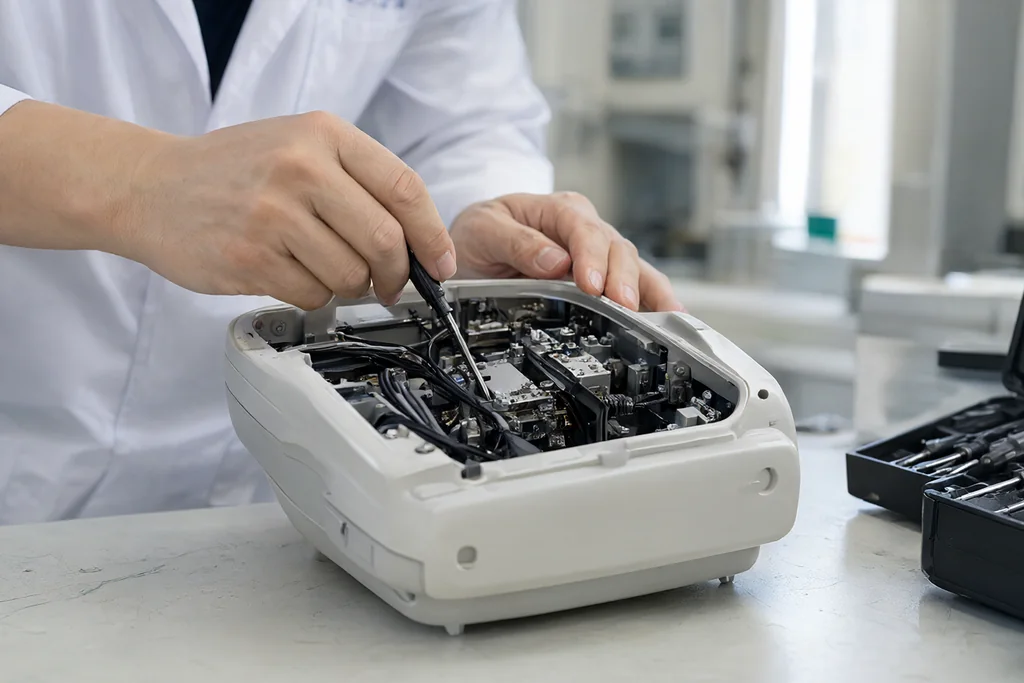
Hospitals own their medical equipment. In practice, ownership often stops at the enclosure. Service keys, proprietary diagnostics, restricted parts and software that refuses to accept a replacement module can leave a hospital dependent on a single provider for work it is legally entitled to do itself.
What the Debate Is Actually About
Right to repair is usually described as a consumer issue, but the clinical version has a narrower shape. It is about whether the owner of a device, or a service organization acting for the owner, can obtain the information, parts, tools and software access needed to maintain it safely.
Nobody credible argues that untrained staff should open an anesthesia machine. The argument is about the middle ground: a hospital with a qualified biomedical team, or a contracted service organization with a functioning quality system, being blocked from work it is competent to perform.
Where the Barriers Sit
The obstacles are rarely stated as policy. They appear as practical details that make independent service uneconomic or impossible, and each one is individually defensible.
| Barrier | What it looks like in practice | Consequence |
|---|---|---|
| Service keys | Diagnostics locked behind vendor-only access | No independent fault isolation |
| Proprietary parts | Components sold only to authorized providers | Longer downtime and higher cost |
| Software locks | Module replacement requires vendor activation | Repair impossible without a dispatch |
| Documentation | Service manuals withheld or restricted | Procedures unavailable to in-house teams |
| End-of-support parts | Vendor stops stocking components | Clinically useful device retired early |
The Manufacturer's Case, Taken Seriously
Manufacturers argue that validated performance depends on the whole system, including the service procedure, the parts and the software state. A substitute component with different tolerances, or firmware never tested with the rest of the device, can move a device outside the configuration that was cleared.
There is also a liability argument. When a device fails after third-party service, establishing what happened becomes harder for everyone, and the manufacturer's willingness to support the device may reasonably depend on knowing its service history.
These are legitimate concerns. They are also frequently used to justify restrictions that go well beyond what safety requires, particularly on older devices where the commercial interest in service revenue is stronger than the interest in continued support.
What Hospitals Actually Need
Strip away the politics and the requirement list is short. Most hospitals are not asking to rebuild devices from scratch; they are asking for enough access to do the work they already have the skills to do.
- Service documentation at the level required to perform the tasks in the contract.
- Diagnostic access, including fault codes and service menus, with a defined support path.
- Parts availability, with a stated period after end of production.
- Software tools and activation rights for replacing a module.
- Training available to in-house teams, not only to authorized providers.
- Clarity about which tasks affect which warranties.
Parts and software access are the two that decide most cases. A hospital that can diagnose but not obtain a component, or obtain a component but not activate it, has not gained independence; it has gained a longer procurement process.
Contract Terms Worth Negotiating
Most of this is settled at purchase rather than at failure. A contract that specifies documentation, diagnostic access, parts availability and an end-of-support date is worth more than a discount, because it determines what the hospital can do years later when the device is out of warranty.
First-right-of-refusal clauses and fully bundled agreements deserve scrutiny. If the only path to a working device is a full-service contract, the hospital has transferred operational control without transferring ownership, and the price of that control is set by one party.
The end-of-support date deserves particular attention. It is the point at which the manufacturer's interest in the device ends, and it is usually earlier than the clinical life the hospital planned for. Matching the two is part of planning preventive maintenance rather than a separate commercial exercise.
Quality and Accountability on the Other Side
The strongest answer to the safety objection is a service organization that can demonstrate a quality system, trained technicians, calibrated tools, documented procedures and traceable parts. Where that evidence exists, the claim that only the manufacturer can service the device becomes harder to sustain.
Accountability has to run both ways. An in-house or third-party repair should produce a record as complete as the manufacturer's: what was replaced, what was tested, what performance verification showed and who signed it. That record is also what protects the hospital if a failure is investigated later.
Reference points help here. Performance verification follows from the device's own specification, and the logic of demonstrating conformity is the same one described in how medical device standards work. A service organization that can describe its work in those terms is easier to defend than one that simply asserts competence.
The Practical Position
Right to repair is unlikely to be resolved by a single regulation, and hospitals cannot wait for one. The workable approach is to treat service access as a procurement requirement, to document what the in-house team can do, and to keep the evidence that shows it does that work to the manufacturer's standard.
Where access is refused and the device remains clinically necessary, the honest options are a service contract at the offered terms, a replacement decision, or a documented risk acceptance for operating equipment that cannot be maintained as intended. The reasoning in when to replace medical equipment is usually the right frame for the third option, because a device nobody can service is already on its way out.
Read next
From Prototype to Market
The work between a working model and a device that can be sold and supported responsibly.
Post-Market Surveillance Explained
How real-world use feeds back into design, labelling and safety communication.
Interoperability in Healthcare Technology
Why devices and systems must exchange information reliably, and what breaks when they cannot.