
Home › Medical Device Industry
Reprocessing single-use devices: regulation, risk and economics
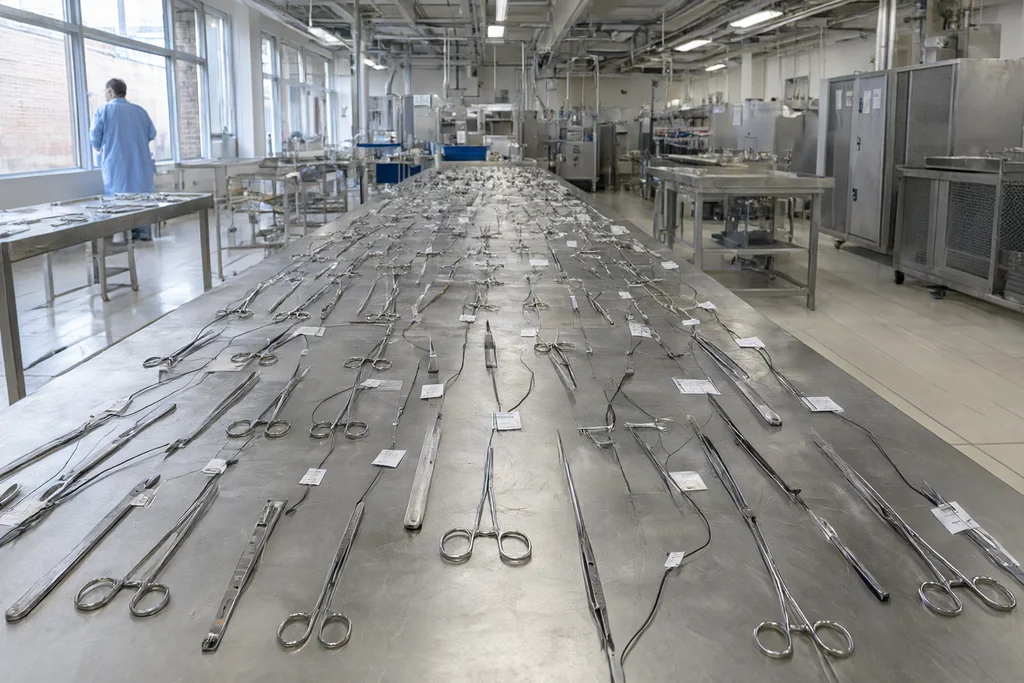
A device labeled single-use is not a device that cannot be cleaned. It is a device whose manufacturer validated it for one use and declined to validate anything beyond that. Reprocessing it is possible, sometimes routine, and always a regulated activity rather than a housekeeping decision.
What Reprocessing Involves
The steps resemble reusable device reprocessing: collection, transport, cleaning, inspection, disinfection or sterilization, packaging, labeling and return. What differs is the starting assumption. A reusable device was designed for the cycle; a single-use device was designed for one procedure, and the reprocessor has to establish that the cycle does not compromise it.
That establishment is the whole difficulty. Cleaning validation for a device with a narrow lumen, a porous surface or an inaccessible channel is not a matter of running it through a washer. It requires a defined worst-case soil, a defined cleaning process, and evidence that the process removes what the soil contains.
How It Is Regulated
Regulation differs by jurisdiction, and the differences are substantive rather than technical. In the United States, third-party reprocessors of certain single-use devices are treated as manufacturers of a new device and must submit validation data and proposed labeling before they can market the reprocessed version.
In the European Union, the position under the MDR is that reprocessing of single-use devices is permitted only where national law allows it, and the reprocessor takes on the obligations of a manufacturer, including conformity assessment and traceability. Hospitals that reprocess in-house fall under the same framework rather than escaping it.
In both systems the underlying principle is the same: someone must be accountable for the claim that the device is safe and effective for another use, and that someone is not the original manufacturer. The original instructions for use become evidence about the device rather than permission to reuse it.
Where the Risk Concentrates
Reprocessing risk is not evenly distributed across the device catalogue. It clusters where geometry, material or contact with the patient makes validation difficult and inspection unreliable.
- Material degradation invisible at inspection but cumulative across cycles.
- Residual contamination in lumens and channels that cleaning validation did not cover.
- Loss of mechanical integrity in seals, connectors and bonded assemblies.
- Labeling that no longer reflects the device's condition or permitted cycle count.
- Traceability gaps that make a recall impossible to execute.
- Cross-contamination during collection and handling before reprocessing begins.
The categories that work best are those with high volume, simple geometry and a clear validation path: compression sleeves, tourniquet cuffs, selected blades and some orthopedic instruments. Categories with long dwell in the patient, complex channels or high mechanical stress are much harder to justify.
Economics Without the Sales Pitch
The economics are usually presented as a per-procedure saving, which is the least informative number in the analysis. The relevant comparison includes collection and transport, the capital and validation cost of the operation, the inventory needed to cover turnaround, and the clinical cost of a device that is unavailable when needed.
Third-party reprocessing concentrates those costs in a contract and removes the operational burden, at the price of dependence on a vendor and a logistics chain. In-house reprocessing keeps control and traceability inside the hospital, but requires validation work, dedicated space and a quality system that can survive inspection.
Neither model is cheap to establish. A program that looks attractive on the device price alone often looks different once collection logistics, the validation dossier and staff time are counted, and the difference is large enough to change the decision.
| Consideration | Third-party reprocessor | In-house program |
|---|---|---|
| Accountability | Reprocessor holds the obligations | Hospital holds them |
| Validation | Built and maintained by the vendor | Built and maintained locally |
| Logistics | Collection and return on a schedule | Internal transport and storage |
| Capital | Minimal, embedded in the price | Equipment, space and staff |
| Traceability | Depends on data exchange | Directly under hospital control |
Clinical Acceptance and Traceability
Clinical acceptance matters as much as the numbers. If surgical teams do not trust the device, or if the labeling creates ambiguity about what is being used, the program will fail regardless of its validation status.
Every reprocessed device also needs to be traceable to its reprocessing cycle and to the patient, in both directions. That requirement is the same one that applies to reusable instruments, and it is the part most often under-built, because it depends on scanning and record discipline at the point of use.
Labeling has to make the reprocessed status visible without creating confusion. The identifier of a reprocessed device is not the identifier of the original, and systems that assume otherwise will produce inventory and recall records that cannot be reconciled.
Deciding Whether It Fits
The decision is usually framed as a finance question and settled by clinical and regulatory ones. A program is defensible when the device category has a validated reprocessing path, the hospital can trace every unit, and the clinical teams accept the product.
It is not defensible when reprocessing exists mainly to relieve supply pressure on a device whose failure would be discovered late. Supply disruption is a legitimate reason to look at reprocessing, but it is not a reason to skip validation.
Seen clearly, reprocessing is a manufacturing activity conducted inside a health system, with the obligations that follow. Treated that way it can be safe and economically sensible. Treated as a way to stretch consumables, it becomes an unvalidated process with a compliant-looking label. The cleaning and disinfection foundations are in reprocessing reusable devices, the risk logic in risk management for medical devices, and the reporting duty in reporting device-related incidents.
Read next
From Prototype to Market
The work between a working model and a device that can be sold and supported responsibly.
Post-Market Surveillance Explained
How real-world use feeds back into design, labelling and safety communication.
Interoperability in Healthcare Technology
Why devices and systems must exchange information reliably, and what breaks when they cannot.