
Low-temperature sterilization: alternatives to steam and their limits
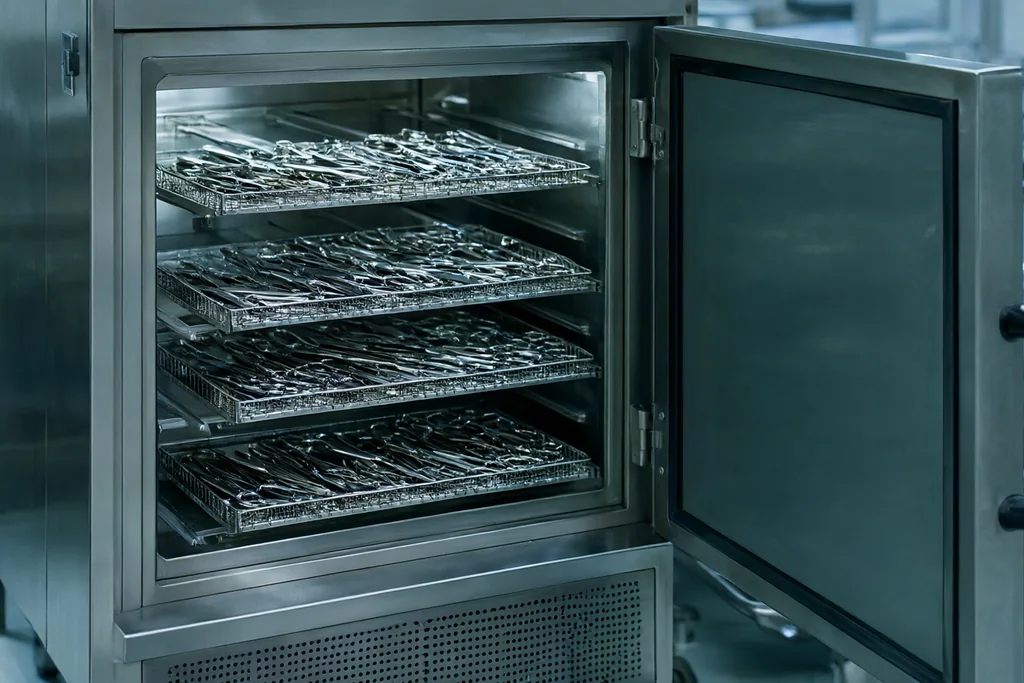
Steam is the default because it is fast, economical, non-toxic and well understood. It is also, for a growing share of devices, impossible to use. Polymer housings, sealed electronics, flexible endoscopes, camera heads and anything with a lumen too narrow for steam to penetrate will not survive a steam cycle, and the answer is a low-temperature process.
Why Steam Cannot Do Everything
Steam sterilization works at temperatures that soften plastics, distort adhesives and destroy batteries. Moist heat also attacks the optical cements and seals used in flexible endoscopes, which is why those scopes have never been a steam load and are handled as a separate reprocessing stream.
Material compatibility is the first filter, and it is not negotiable. A device whose instructions for use specify a low-temperature process is not a candidate for improvisation, whatever the material list in a catalogue appears to suggest.
The Main Alternatives
Ethylene oxide remains the broadest of the alternatives. It penetrates packaging and long lumens well, works at temperatures most materials tolerate, and is compatible with a very wide range of devices. Its disadvantages are equally well known: the gas is toxic and carcinogenic, cycles are long because loads require aeration, and the process demands tight controls on exposure and emissions.
Hydrogen peroxide systems, whether vaporized or in a gas plasma cycle, are faster and leave no toxic residue, which makes them attractive for heat-sensitive instruments in fast turnover. They are also far less forgiving: lumen length and diameter are restricted, cellulose-based packaging absorbs the sterilant, and load density affects penetration.
Peracetic acid in liquid form is used for immersion of heat-sensitive items such as endoscopes, usually in automated reprocessors. It is effective at low temperature and leaves no toxic residue after rinsing, but it is corrosive to some metals and the rinse step is part of the process rather than an optional extra.
Other Processes in Use
Nitrogen dioxide and supercritical carbon dioxide systems occupy a smaller share of the market and are usually chosen for specific device families rather than as general-purpose alternatives. Radiation methods such as gamma and electron beam are industrial processes used at manufacture, not in a hospital sterile processing department.
The practical point is that low temperature describes a temperature range, not a single process. Each method has its own compatibility profile, cycle constraints, packaging requirements and monitoring approach, and they are not interchangeable.
What the Instructions for Use Govern
The manufacturer's reprocessing instructions are the controlling document. They name the methods validated for the device, sometimes the number of permitted cycles, and often the specific constraints: maximum lumen length, permitted packaging, restrictions on load composition. A method that is not listed has not been validated for that device, however plausible it looks.
This is where the practical conflicts appear. A department may hold one low-temperature technology and a device that requires another, and the correct outcome is to send the device elsewhere rather than to run it through the machine that happens to be free. The same discipline applies to reusable instruments generally, as set out in reprocessing reusable devices.
| Method | Typical use | Main constraints |
|---|---|---|
| Ethylene oxide | Long lumens and complex assemblies | Toxicity, aeration time, emission controls |
| Hydrogen peroxide | Fast turnover of heat-sensitive items | Lumen limits, packaging absorption, load density |
| Peracetic acid immersion | Flexible endoscopes in automated reprocessors | Corrosion, rinse requirements, point-of-use logistics |
| Nitrogen dioxide | Selected heat-sensitive devices | Narrower compatibility list, limited availability |
Validation, Monitoring and the Weak Points
Low-temperature processes are harder to monitor than steam because the parameters are less familiar to staff who learned on autoclaves. Biological indicators remain the strongest evidence, but the choice of organism has to match the process, and a monitor validated for one method proves nothing about another.
Chemical indicators are process-specific for the same reason. An indicator that responds to steam conditions tells you nothing about an ethylene oxide cycle, and using a general-purpose strip as evidence is a common and quiet error.
Load configuration is the other recurrent failure. Low-temperature chambers are often smaller, loads are more heterogeneous, and a single item positioned so that sterilant cannot reach a lumen will fail without producing an obvious signal on the chamber record.
Maintenance matters more here than the equipment's age suggests. Door seals, vacuum systems, vaporizers and concentration monitors all drift, and a cycle that ran within specification last year may be marginal now. Reviewing the pattern rather than individual cycles is what makes the drift visible.
Choosing Between Methods
Selection is usually presented as a technology comparison, but the constraints that decide it are logistical. Volume, turnaround, device mix and the availability of qualified staff determine which method a department can actually run safely.
- Start from the device inventory: which items are excluded from steam, and by which instruction.
- Group those items by the process their manufacturers validated, not by material similarity.
- Check volume and turnaround against what each method can realistically deliver.
- Confirm packaging and consumables are compatible with the chosen process.
- Plan monitoring, aeration and emission controls before the equipment arrives.
- Record which devices route to which process, and review the list when devices change.
Low-temperature sterilization is not a substitute for steam. It is a set of narrower processes for the devices steam would destroy, and each carries its own constraints on materials, load configuration and monitoring. Getting it right depends less on the equipment than on knowing which devices require which process, and on refusing to send anything through a cycle its manufacturer never validated. The underlying principles are covered in sterile processing basics, and the evidence question in monitoring sterilization quality.
Read next
Sterile Processing: The Basics
The full journey a reuseable instrument takes, and why each stage matters to the next one.
Steam Sterilization Explained
The conditions steam needs to work, and the everyday reasons a cycle fails to reach them.
Reprocessing Reuseable Devices
Manufacturer instructions, validation and the limits of what can safely be reused.