
Competency in sterile processing: what to assess and how to record it
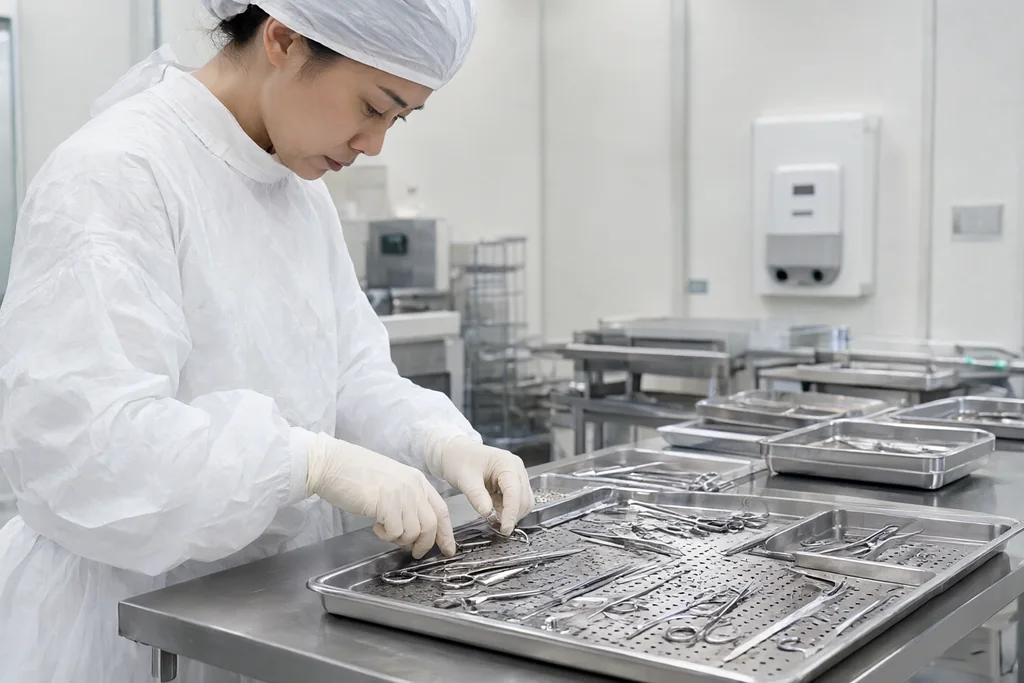
Every sterile processing department has a training file. Far fewer have evidence that the people in the department can do the work reliably, on the shift they actually work, with the instruments they actually receive. The gap between those two things is what a competency program exists to close.
Training Is Not Competency
Training records attendance. Competency records performance. A technician who sat through the packaging module has been trained; whether the pouches they produce are sealed within specification is a separate question that only observation answers.
The distinction matters because most processing failures are not knowledge failures. People know that a tray must not be overloaded, and trays are still overloaded at the end of a difficult shift. Competency is about behavior under pressure rather than recall of a slide.
What to Assess
The list should follow the workflow rather than the org chart. Decontamination, inspection and assembly, packaging, loading, sterilizer operation, interpretation of monitoring results and documentation each carry their own observable skills and their own characteristic failure mode.
Writing the list as tasks rather than topics is what makes it assessable. "Understands sterilization" cannot be observed; "loads a mixed instrument set so that steam reaches every surface and records the configuration" can be watched, described and repeated.
| Area | Observable competence | Evidence |
|---|---|---|
| Decontamination | Correct protection, chemistry and contact time | Direct observation, log sheets |
| Inspection | Finds damage, residue and misalignment | Seeded-fault test trays |
| Packaging | Correct material, seal and label for the method | Sealed sample audit |
| Loading | Configuration matches the validated pattern | Photographed load records |
| Monitoring | Reads results and decides release correctly | Scenario questions, release decisions |
| Documentation | Records complete and traceable | Retrospective record audit |
How to Assess It
Direct observation is the backbone. A trained assessor watches the task performed on real instruments against a checklist that describes what correct looks like, and records what happened rather than a bare pass mark.
Return demonstration adds a second layer: the technician explains why a step matters while performing it, which surfaces understanding that mimicry hides. Seeded faults, where a damaged instrument or an incorrect indicator is introduced deliberately, test inspection in a way a written test cannot.
Record review catches what observation misses, because paperwork shows what happened on shifts nobody watched. A sample of load records, released loads and missing-entry exceptions usually reveals whether the system holds up when the department is busy.
Documentation That Survives an Audit
A competency record is only useful if it names the task, the standard applied, the assessor, the date and the outcome. A line reading "annual competency completed" tells a surveyor nothing and tells a manager less.
Where a technician does not meet the standard, the record should show the remediation and the reassessment rather than a discreet gap. Auditors are less interested in a perfect file than in a file that demonstrates the department notices and corrects its own problems. The same record discipline runs through reprocessing reusable devices, where every step has to be traceable to the patient.
Reassessment and Trigger Events
A single annual sign-off is the weakest form of the exercise, because it certifies everything and observes almost nothing. Reassessment works better when it is tied to events that change what a person is being asked to do.
- On hire, before independent work, with a defined supervision period.
- Annually, on a schedule that rotates through every task rather than one generic form.
- After an incident or a near miss involving that task.
- When a new device family, packaging system or sterilizer enters service.
- After a procedure change or a revised instruction for use.
- When a technician returns from a long absence or moves to another shift.
The Gaps That Persist
Agency and temporary staff are the classic gap. They arrive competent on paper, cover the shifts nobody wants, and are rarely included in the observation schedule. Off-shift work is the second: assessment often happens on days, while the questionable practice happens at night.
Supervisors are the third. The person signing the records is seldom assessed by anyone, and a supervisor who has drifted into a shortcut will teach it to everyone they train. Including leads in the schedule is uncomfortable and necessary.
Building the Program
Start with the tasks that cause harm when they fail: cleaning efficacy, inspection, packaging integrity, load configuration and release decisions. Build a checklist for each that describes observable behavior, then schedule observation across all shifts rather than the convenient one.
The program also has to be resourced. Observation takes time from a department usually short of it, and a scheme that exists only on paper is worse than none because it creates false assurance. Linking it to the equipment records described in building a preventive maintenance schedule keeps competency connected to the wider system rather than floating as a training exercise.
Competence is finally a claim about what happens on the worst shift, not the best one. A department that can show observation records across shifts, assessments that respond to change, and corrections made before an auditor asked has something more useful than a training file: evidence that the process works when nobody is watching. That evidence is also what makes the monitoring data in monitoring sterilization quality worth trusting, because someone competent has to interpret it.
Read next
Sterile Processing: The Basics
The full journey a reuseable instrument takes, and why each stage matters to the next one.
Steam Sterilization Explained
The conditions steam needs to work, and the everyday reasons a cycle fails to reach them.
Reprocessing Reuseable Devices
Manufacturer instructions, validation and the limits of what can safely be reused.